Posts Tagged ‘Arizona State Hospital’

ASH CEO Position

May 15th, 2013

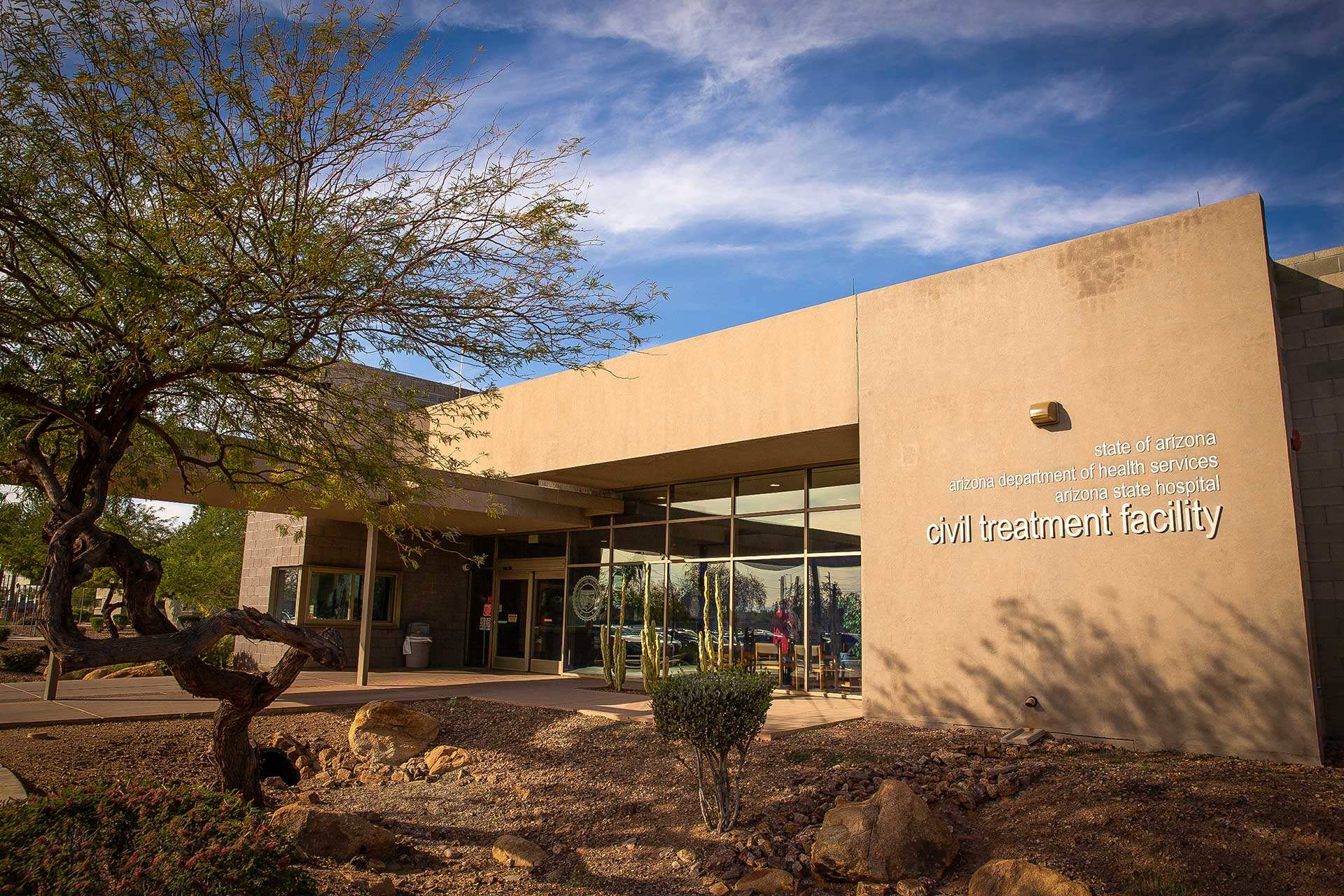
Now that Cory Nelson has officially been appointed as our Deputy Director for Behavioral Health, we’re moving full steam ahead to recruit for the Chief Executive Officer of the Arizona State Hospital.  The CEO is a critical member of our team and has the responsibility of managing the day-to-day operations of the civil, forensic and sex offender units located on the campus.  This is a great opportunity for someone interested in being part of some of the most exciting changes happening at the hospital in years.  

Recently the hospital hit ten-month lows in the use of seclusion, restraint and patient falls… all as a result of new efforts that have been put in place to create culture change that engages patients and staff in the overall success of treatment.  The focus on Recovery, Trauma Informed Care using evidenced-based are all coming into full swing and present opportunities to even further improve the lives of patients on the campus.  Anyone interested in applying of for the position should submit an application through the State of AZ Jobs Site and look under the Department of Health in the agency section.


Blessing Bag Update

February 15th, 2013

I wanted to update on one of my December blog posts.  Around the holidays, patients at the Arizona State Hospital decided to take on a project – to help the homeless.   Patients wanted an opportunity to give back to the community in a way that would help those in need.  They chose a project working with the Phoenix Rescue Mission to create Blessing Bags to give to the homeless. Since many patients have been homeless in the past, they know what it’s like to have nothing. 

The patients collected donations for the Blessing Bags during the month of December. They collected travel size hygiene products, small snacks, gloves, socks etc.  Some patients even donated what they earned from the point store.  Then they filled gallon size plastic bags with donated items.  The patients also included a hand written inspirational note in each bag.  They ended up with more than 150 bags which will soon be distributed by the Rescue Mission.


New State Hospital Treatment Approach Leads to Improved Outcomes

February 12th, 2013

One priority at ADHS is helping patients on their path to Recovery at the State Hospital.  Our Hospital team cares for people who have mental health issues, whether for civil reasons or committed through the criminal courts.  We also oversee the Arizona Community Protection and Treatment Center.

Recent changes in security are making the Hospital a better place for patients, staff and the public. In the last four months – we’ve greatly reduced injuries to patients and staff – 23% for patient on patient assaults, 72% for patient on staff assaults; and we’ve reduced injuries by 83% for staff injuries from patient assaults, 26% for patient self injury. Why is this happening?

About a year ago, we began the transition to a new model with a cohesive team approach where direct care staff is fully engaging in all aspects of care.  This “Culture of Care” creates a better therapeutic environment for patients and residents to live and improve safety for everyone.  We’ve trained more than 700 staff on Non-Violent Crisis Intervention, an evidence-based, best practice for early intervention and de-escalation created by the Crisis Prevention Institute.  That’s allowed us to focus our staffing on direct patient care and overall hospital safety.  In the past few years, we’ve been able to maintain a good staff to patient/resident ratio by repurposing positions from administration and other supporting areas to areas that work directly with patients/residents on a daily basis.

The change has also helped us reduce seclusion and restraint, both major risk factors for psychiatric hospitals.   We’ve been able (under the new system) to dramatically reduce the number of injuries by 13% from 2011 to 2012… this year we’ve only had five… representing a 75% drop from the previous two years for the same time frame.  On the seclusion and restraint side, we’ve experienced an 80% reduction in just the last four months.  These are great changes that we expect to continue. 

Some other major changes to safety and security at the hospital in the last year include new scheduling to increase the number of staff available during high patient activity times, safer procedures when patients have to leave the hospital and revamping the way we review incidents with patients and staff.  The staff and leadership at the hospital have made tremendous strides to make it a better and safer place to work, live and reach recovery.  Nice job Team ASH!


Patients’ Drive to Help Homeless a Success

February 11th, 2013

I wanted to update on one of my December blog posts.  Around the holidays, patients at the Arizona State Hospital decided to take on a project – to help the homeless.   Patients wanted an opportunity to give back to the community in a way that would help those in need.  They chose a project working with the Phoenix Rescue Mission to create Blessing Bags to give to the homeless. Since many patients have been homeless in the past, they know what it’s like to have nothing.

The patients collected donations for the Blessing Bags during the month of December. They collected travel size hygiene products, small snacks, gloves, socks etc.  Some patients even donated what they earned from the point store.  Then they filled gallon size plastic bags with donated items.  The patients also included a hand written inspirational note in each bag.  They ended up with more than 150 bags which will soon be distributed by the Rescue Mission.

Behavioral Health Annual Report

January 10th, 2013

Our Behavioral Health Services team just finished and published our FY 12 Annual Report.  The new report identifies the number of clients served by service area, funding category and program; and includes programmatic financial reports of revenues, expenditures and administrative costs.  In it, you’ll see that we received a total of about $1.46B in funding for FY 2012 for behavioral health services.  Our Agency administrative costs were about 1% of the total (about $18M). 

The report shows our revenues and expenditures (including specific identification of administrative costs) for each behavioral health program category (The Seriously Mentally Ill; Alcohol and Drug Abuse; Severely Emotionally Handicapped Children; Domestic Violence; and the Arizona State Hospital).


Patient-driven Solution Needs Your Help

December 13th, 2012

The Patients and Hospital Rehab Departments at the Hospital are working together with the Phoenix Rescue Mission (homeless shelter) to create Blessing Bags. Blessing Bags are large gallon sized Ziploc bags filled with basic necessities which will be handed out by the Phoenix Rescue Mission to the homeless. 

But they need some donations to get going.  The patients would like to begin assembling bags soon so they’re  asking for any donations to be received by December 31.  The rehab department has placed boxes to collect the items in various areas around the hospital and in the lobby of the 150 Building.  They need donations of:  gallon size Ziploc bags, chap stick, packages of tissues, toothbrushes, mouthwash, shampoo (small sizes), combs, soap, band aids, hand-wipes, socks, gift cards for retail stores, trail mix, granola bars, crackers, and/or gum or mints. 

Anything on the list above that you can bring in over the next week or so will really help. The contact at the Hospital is Jackie Tisler, Director of Rehab Services – Jacqueline.tisler@azdhs.gov (602.220.6171). Donations can be dropped off at the Arizona State  Hospital civil lobby (501 N. 24th St) or the Arizona Department of Health Services 150 Building lobby.


Thanksgiving, ASH & the Territorial Cup

November 21st, 2012

Our Arizona State Hospital (ASH) and the U of A share a birthday.  Both were established by the 13th Territorial Legislature in 1885.  The City of Tucson had wanted ASH (it came with a $100K appropriation) but their delegation got to Prescott (the Territorial Capitol) late because the Salt was flooded…  and Tucson ended up getting the U of A instead (which only carried a $25K appropriation).  ASH opened its doors in 1887 and the U of A held their first classes in 1891. 

The UA football team played their first games in 1899 as the U of A “Varsity”… and the first Big Game between the Varsity and the Tempe “Normals” (ASU) was played on Thanksgiving in 1899 at Carillo Gardens field in Tucson in front of 300 fans. The U of A met the Normals at the Tucson train station and the teams had a post-game Thanksgiving feast.  I don’t think they do that anymore—  or we’d probably have to test the food in advance at our Lab.   The local newspaper reported that this was U of A’s first game and that “… the Normal squad was physically larger and better conditioned”, with the Normals winning 11 to 2.  The Territorial Cup is the trophy that’ll be awarded again to the winner of Friday’s Duel in the Desert (in Tucson this year)…   it’s the oldest Trophy of its kind.

Our New Strategic Plan

October 17th, 2012

The vision of the Department is to ideally achieve a state of Health and Wellness for all Arizonans and our mission is to promote, protect, and improve the health and wellness of individuals and communities in Arizona. The updated mission and vision statements are helping us build public health value in-house as well as in the community.  The format was modernized and ADHS is making an effort to educate our partners and reinvigorate staff on our goals.

We’re among the largest and most complex of state agencies. With over 1,600 employees and an annual budget of more than $1.8B, we provide a wide variety of services and a diversity of programs housed within its five divisions: behavioral health; licensing; planning and operations; public health prevention; and public health preparedness. The two-fold mission of public health services includes prevention and preparedness for the state. The public behavioral health system oversees services for 150,000 enrolled clients and the state’s only public psychiatric hospital, the Arizona State Hospital. The division for licensing is charged with certification of nursing homes, assisted living and child care centers, hospitals and other health care facilities. The division for planning and operations oversees the budget, procurement, audit and special investigations, information technology, workforce development, rule-making, human resources, policy, continuous quality improvement, and accreditation.

Our strategic priorities are the pathways we use to achieve targeted improvements in public health outcomes. We’re committed to moving along with our partners in local health departments toward voluntary public health accreditation. The work towards accreditation will require the agency to look at the statewide public health system as a whole, collaborate with stakeholders, and provide evidence that our work meets the ten essential public health services. The ten essential services were set as a national standard in 1994 by a steering committee consisting of all US Public Health Service agencies and representatives from other major public health organizations. Accreditation focuses on quality, transparency, and partnerships. Through the accreditation process, our leadership will identify strengths, weaknesses, and opportunities for continuing to build public health infrastructure in a way that will best align our resources with key priorities.

Our new updated Strategic Plan lays out the framework for how we’ll use quality improvement, lean methodologies, best practices, and strategic alignment to achieve our vision of “Health and Wellness for All Arizonans

Evidence Based Practice x (Training + Teamwork) = Results

August 17th, 2012

We’ve been implementing an evidence-based practice called Non-Violent Crisis Intervention as our operational model at the AZ State Hospital for the last few months- and we’re already seeing dramatic results.  It’s a best practice for early intervention and de-escalation created by the Crisis Prevention Institute.  It’s based on teamwork and training.  By using a cohesive team that’s fully engaged in all aspects of care, we create an environment that’s therapeutic for patients/residents and safe for everyone while providing our team with a rewarding work environment and a Culture of Care.

Good news…  since implementing our Non-Violent Crisis Intervention training we’ve dropped the % of incidents at the Hospital that end up in restraint or seclusion by over 40%.  Equally encouraging is the fact that staff injury has been reduced by nearly the same amount.  Our team at the hospital is doing a great job of using a recovery-based and trauma-informed approach in applying the de-escalation principles that are the key to these results.  You can read more about Non-Violent Crisis Intervention on the Crisis Prevention Institute website.

Implementing this new strategy hasn’t been a cakewalk.  Everybody has been through intensive training- and making a shift like this can take folks out of their comfort zone.  But I’ve found over the years that sometimes the best way to grow and achieve is to put yourself outside your comfort zone and reach.  Well done!

Acting Deputy for Behavioral Health

August 5th, 2012

Thanks for your patience as we developed our continuity plan for leadership in our Division of Behavioral Health.  I know you’re  all anxious to hear the transition plan for after Dr. Nelson leaves on August 24.  Fortunately, we are very lucky to have so many strong leaders here at the agency, including a really great team of DBHS Branch Chiefs and Bureau Chiefs.  Many of you will be key in helping to make this time period a success, and we’ll be looking to you to keep our great momentum going!

We’ve already posted the Deputy Director position and have had interviews underway for the Assistant Director position.  I think we’ll move smoothly with filling both of these positions permanently in the near future.  In the interim, I’ve asked Cory Nelson, AZ State Hospital CEO to serve as the Acting Deputy Director- and he’s agreed to help out.  Cory will spend the next three weeks working closely with Dr. Nelson and the rest of the team and should have no problem getting up to speed- as he’s a quick study.  This plan will offer a great opportunity to further strengthen our important link between the Hospital and the community-based behavioral health system.  It’ll also bring in additional people-power to DBHS during this incredibly busy time.  Cory has a great team at the Hospital as well and they’re up to the task of picking up some of Cory’s day-to-day work there.  Donna Noriega will be leading the team at the hospital as Acting CEO and will be working closely with the rest of the leadership team to make sure the great things happening there keep moving forward.

Some may ask why Bob Sorce, our fearless Assistant Director, has not been asked to serve as Acting Deputy Director. While Bob is very capable and no doubt would do a good job in that role, his current assignment in managing the Maricopa County RBHA RFP project is at a critical stage with the expected release of the RFP next month. Given the importance of this project, I am not willing to disrupt the positive momentum that has been building over the last several months by reassigning him to a different position.   Bob, along with the rest of the RFP Core Team must continue to spearhead  this important work as well as prepare for the monumental changes to health care that are expected on January 1, 2014 when federal healthcare reform is set to kick in.  Bob will also serve as back-up to Cory and assist whenever needed.  As I have previously said, we’ll continue with our mission as a team and I feel good about the team we have in place.

It’s nice to know that we have a strong team in place throughout the Agency- which gives me comfort that we’ll make it through this transition effectively.